
GORAKHPUR CITY GUIDE
A relaxed three-day itinerary3 Days in Gorakhpur
A relaxed three-day journey through spirituality, living craft, lakeside evenings and nearby Kushinagar.
Gorakhpur rewards travellers who don't try to see it as a checklist.
A good three-day visit moves between very different sides of the city: the quiet devotional atmosphere of Geeta Vatika, the living terracotta tradition still practised in villages outside the city, the scale and energy of Gorakhnath Temple, an evening beside Ramgarh Tal, and a full-day journey to nearby Kushinagar, one of Buddhism's most important pilgrimage destinations.
This itinerary is designed around a real stay rather than three artificially packed sightseeing days. Your first day begins when you arrive, so it remains deliberately light. The second day explores Gorakhpur itself at a slower pace, while the third is reserved for Kushinagar.
Quick Facts
- Ideal stay
- 3 days / 3 nights
- Best suited to
- First-time visitors, couples, families, spiritual and cultural travellers
- Pace
- Comfortable
- Main experiences
- Ramgarh Tal, Geeta Vatika, Gorakhpur Terracotta, Gorakhnath Temple, Kushinagar
- Good time to visit
- October to March for generally more comfortable sightseeing
- Getting around
- Private car/cab, particularly for Aurangabad and Kushinagar
3 Days at a Glance
Day 01
Arrive & Unwind
- Morning
- Arrive in Gorakhpur and settle in
- Afternoon
- Optional Gita Press if your arrival time allows
- Evening
- Ramgarh Tal around sunset
Day 02
Spirituality & Craft
- Morning
- Early Geeta Vatika and morning aarti
- Afternoon
- Aurangabad Terracotta Village
- Evening
- Gorakhnath Temple and evening aarti
Day 03
Kushinagar Day Trip
- Morning
- Leave for Kushinagar
- Afternoon
- Mahaparinirvana and other Buddhist sites
- Evening
- Return; Rail Museum if time permits, otherwise Ramgarh Tal
Getting to Gorakhpur
By Air
Gorakhpur Airport
Gorakhpur Airport provides the simplest air access to the city. The Airports Authority of India currently lists direct connections with Delhi, Mumbai, Hyderabad and Kolkata. Routes and frequencies can change, so travellers should always check the current schedule when booking. Taxis and app-based cab services are available outside the airport gate. AAI
10 Park Street is in Civil Lines in central Gorakhpur. Actual journey times from the airport vary with traffic, so current directions are more useful than promising a fixed transfer time.
By Train
Gorakhpur Junction
Gorakhpur is one of the major railway centres of eastern Uttar Pradesh and is well connected by rail with cities across India. For guests staying centrally, reaching the hotel after arriving at Gorakhpur Junction is a short city transfer.
If you are travelling with substantial luggage, taking an auto-rickshaw or cab is generally easier than planning the final kilometre purely around walking.
By Road
Gorakhpur is connected by road with the surrounding region and works particularly well as a base for travellers combining eastern Uttar Pradesh with Kushinagar and other destinations in the Buddhist circuit.
For this particular itinerary, having a car or cab on Days 2 and 3 makes the experience considerably easier, since the terracotta village and Kushinagar lie outside the central sightseeing area.
Before You Visit
This itinerary is intentionally flexible.
If you reach Gorakhpur early, you can include Gita Press on the first afternoon. If you arrive late, skip it without feeling that your trip has been compromised. Likewise, the final evening after Kushinagar depends on your return time and energy: the Rail Museum is an option, while Ramgarh Tal is the easier choice after a long day.
Temple schedules can also change on festivals and special occasions. Dress respectfully, expect to remove footwear in temple areas and allow extra time during major religious dates.
Detailed Itinerary
Day 1: Arrive & Unwind
- Start / end
- Arrival to evening
- Pace
- Deliberately light
Your first day begins when you arrive. The best first day in Gorakhpur is not one packed with monuments.
Whether you arrive by flight, train or road, use the first part of the day to check in, have something to eat and settle into the city. Saving the major spiritual visits for the following morning makes the itinerary far more relaxed.
If you arrive with enough time before the late afternoon, there is one worthwhile optional stop. Meet Gorakhpur at the lake around sunset.
-
Optional stop
Gita Press
Best for: travellers interested in Hindu spiritual literature, publishing history and Indian religious culture
Gita Press is not something every traveller needs to include, which is precisely why it works well as an optional first-day visit.
For someone interested in Hindu texts or the history of Indian publishing, however, it is one of Gorakhpur's most distinctive institutions.
Established in 1923, Gita Press describes itself as the world's largest publisher of Hindu religious texts. Its publishing work includes the Bhagavad Gita, Ramayana, Upanishads, Puranas and other religious and philosophical literature. Its archive contains thousands of manuscripts and interpretations of the Bhagavad Gita. Gita Press
The entrance itself is worth noticing. Gita Press explains that different elements of its architecture draw from historic Indian temple forms, including Ajanta, Ellora and Meenakshi Temple, creating a deliberately pan-Indian architectural composition. Gita Press
The Gorakhpur district tourism site also highlights the marble inscriptions and visual depictions of episodes from the lives of Rama and Krishna. Gorakhpur
Should you include it?
Go if books, Hindu philosophy, religious history or publishing interest you.
Skip it if you have arrived late, are travelling with young children who need a break, or simply prefer to spend your first few hours relaxing.
Practical note: opening information published online is inconsistent, so check current visitor access before setting out rather than relying on a fixed time printed months in advance.
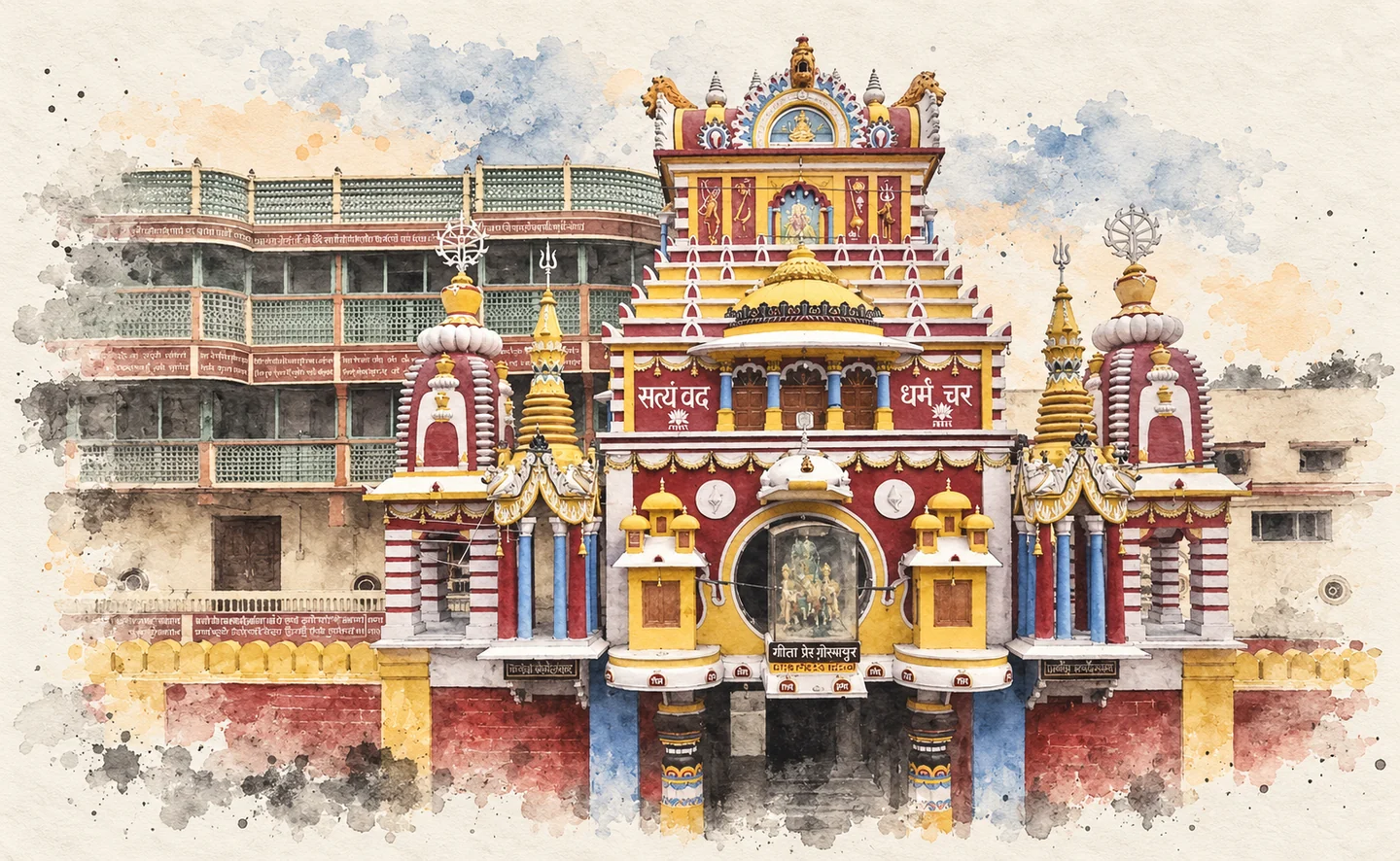
Gita Press, Gorakhpur -
Stop 02
Ramgarh Tal
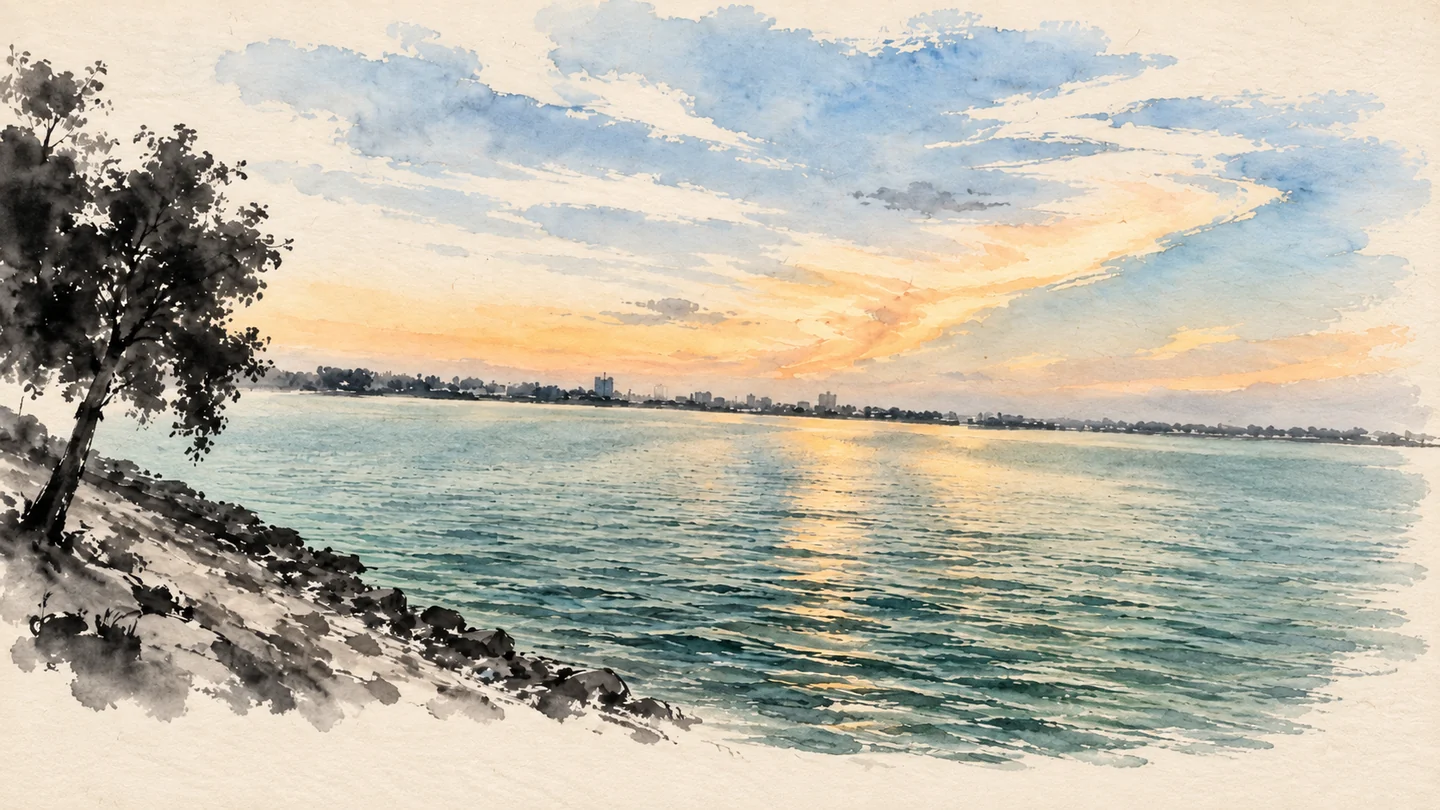
After travelling, Ramgarh Tal is an ideal first introduction to Gorakhpur.
Rather than beginning with a busy temple or museum, you arrive at the lake when the temperature starts to soften and the city begins transitioning into evening.
The district administration describes Ramgarh Tal as a natural lake spread across roughly 1,700 acres and identifies boating and colourful fountains among its recreational attractions. Gorakhpur
But you do not need to treat it as an “attraction” that requires a programme.
The pleasure is simply in being there.
Walk along the developed lakefront. Find a comfortable spot to watch the light change. Take a boat ride if operations and weather permit. Families can spend longer around the recreational areas, while couples may prefer a slower stroll around sunset.
The best way to experience it
Aim to arrive before sunset rather than after dark.
This gives you time to see the water in daylight, watch the sky change and stay as the lakefront lights begin coming on.
During winter, sunset comes considerably earlier than in summer, so adjust the afternoon accordingly.
If your flight or train arrives late
Skip everything else and go directly to the hotel.
There is no need to “make up” the missed sightseeing. You will have another opportunity for a Ramgarh Tal walk on the final evening.
End Day 1: Dinner and a relaxed night.
Ramgarh Tal at sunset
Day 2: Spirituality & Craft
- Start / end
- Early morning to evening
- Pace
- Calm morning, cultural afternoon, atmospheric evening
This is the day that reveals the most about Gorakhpur itself.
It begins quietly, moves out towards one of the region's distinctive craft traditions and ends at the city's best-known spiritual landmark.
The rhythm is intentional: calm morning, cultural afternoon, atmospheric evening.
-
Stop 01
Geeta Vatika
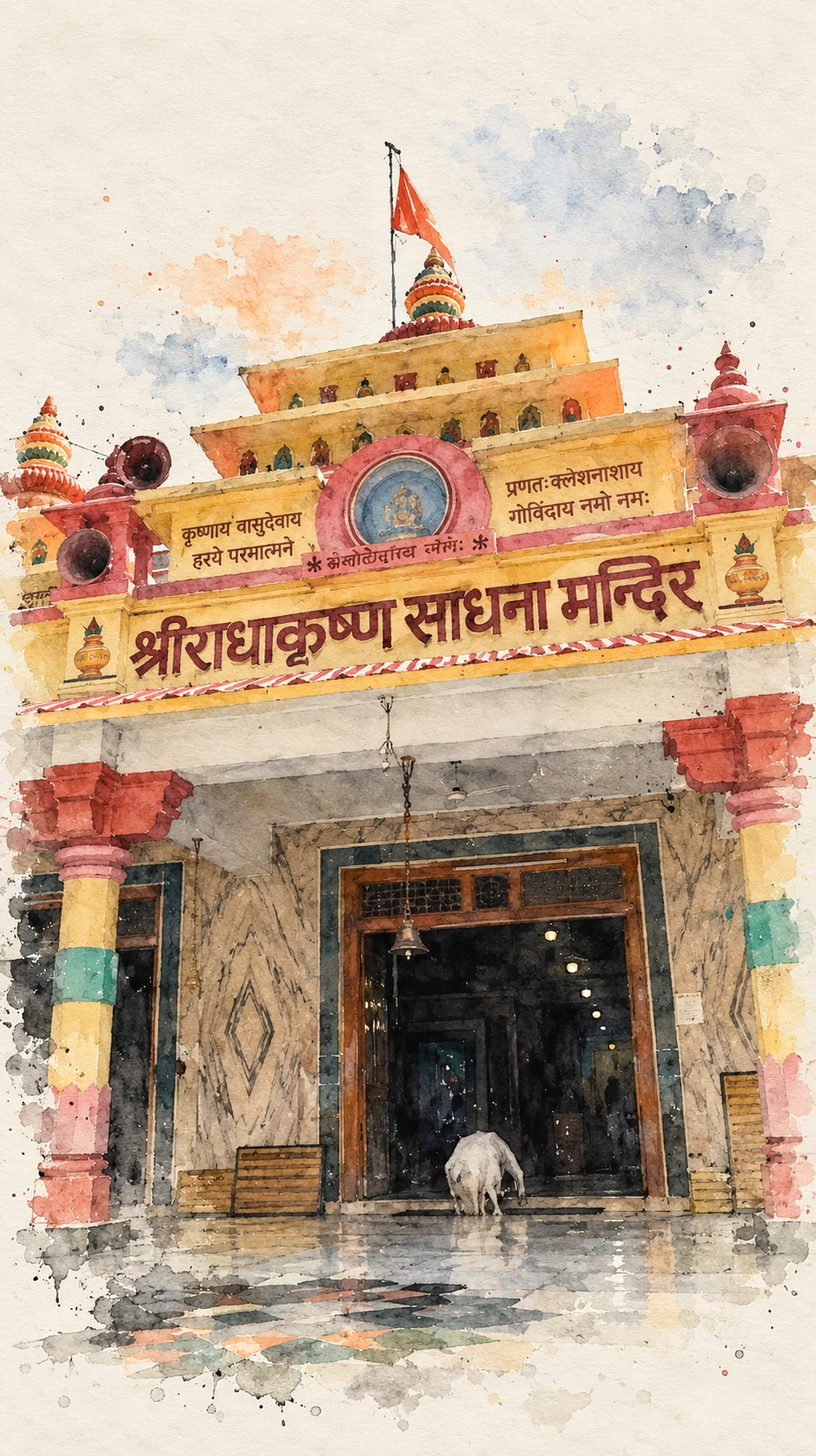
Geeta Vatika, Gorakhpur 6:30–7:00 AM — Arrive before the morning aarti
Geeta Vatika is best experienced early.
The district's tourism information places it near Asuran Chowk and describes its Radha-Krishna temple and longstanding devotional tradition. Most notably, it states that continuous Hare Rama–Hare Krishna chanting has continued in the complex since 1968. Gorakhpur
The place is closely connected with Bhaiji Hanuman Prasad Poddar, the noted editor of Kalyan. Geeta Vatika's own site describes the complex as the place from which he lived and worked for decades. गीता वाटिका
That history matters, but the main reason to come early is atmosphere.
At this hour, you are not visiting simply to look at a temple facade. The chants, morning light, gardens and relative quiet combine to create the kind of experience that disappears once a day becomes busy.
Morning aarti
A current temple visitor guide lists:
Morning temple session: 6:00 AM–12:00 PM
Morning aarti: 7:00–8:00 AM. srimandirConfirm the current morning aarti schedule before visiting:
Allow yourself to stay after the aarti
Don't leave the moment the ceremony finishes.
Spend another 20–30 minutes walking quietly around the complex. The point of putting Geeta Vatika first in the day is precisely to avoid making it another hurried stop.
Breakfast & Continue Towards the Terracotta Villages
After Geeta Vatika, have breakfast before continuing towards the Bhathat/Aurangabad area.
There is little value in driving back and forth through central Gorakhpur simply to tick off more landmarks. This day works because the morning naturally continues out towards the terracotta-producing villages.
-
Stop 02
Aurangabad Terracotta Village
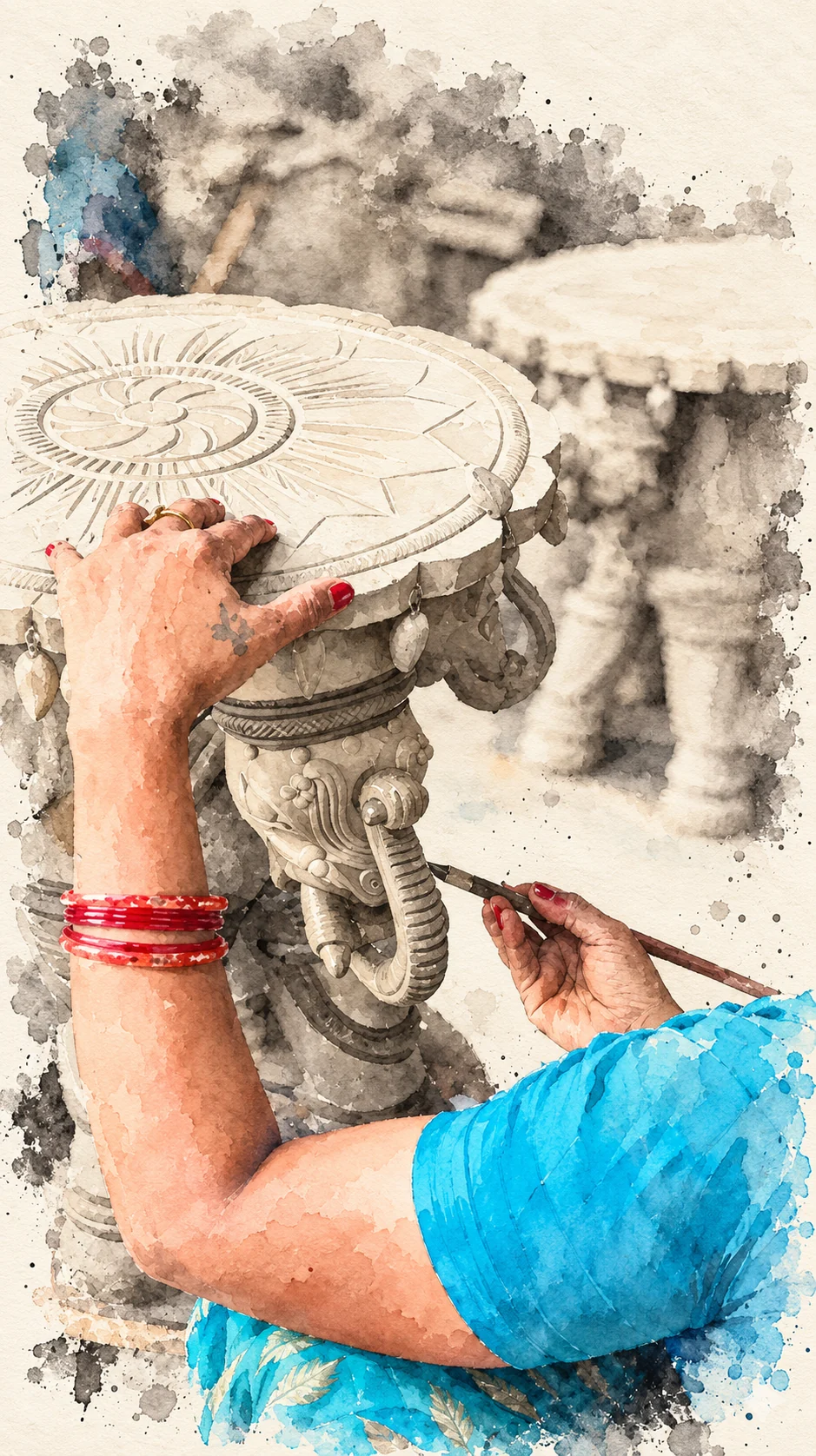
Terracotta work in Aurangabad A craft that belongs specifically to Gorakhpur
Gorakhpur's terracotta deserves more than a shopping paragraph.
The craft is recognised as a Geographical Indication (GI) and uses a locally sourced clay known as Kabis. The Government of India's handicrafts information identifies Aurangabad among the villages from which this distinctive clay and craft tradition emerge. Handicrafts
The process is remarkably rooted in local materials.
The clay is refined and shaped into objects that range from lamps and vessels to elaborate animal and human figures. Pieces are traditionally treated with a mixture involving soda and mango bark before firing, helping produce the characteristic warm red surface. The terracotta horse has become one of the craft's signature forms. Handicrafts
Aurangabad itself is now being developed as a Special Tourist Village, with plans centred on craft tourism and giving visitors closer access to Gorakhpur's terracotta tradition. Outlook Traveller
What makes this different from visiting a handicraft shop?
You are going to the place where the craft is made.
This is a working artisan environment rather than a conventional tourist attraction with turnstiles, fixed guided-tour slots and a souvenir shop at the exit.
That difference is important.
Depending on the artisan and what stage of production is taking place, you may see clay being prepared, pieces being shaped, decorative details being added, finished figures waiting for firing or completed works displayed for sale.
If you simply arrive without arranging anything, the experience may be shorter and more unpredictable.
Plan ahead
Buying terracotta
If something genuinely appeals to you, buying directly from the artisan is one of the most meaningful souvenirs you can take home from Gorakhpur.
It also turns the visit into direct support for the people continuing the craft rather than merely consuming it as a tourist display.
The Government of India's tourism information similarly encourages purchasing directly from local craftspeople as a way to support the tradition. Incredible India
What to look for
The characteristic horses are an obvious choice, but don't overlook smaller figurines, lamps, decorative pieces and forms inspired by nature, mythology and everyday life.
And look at the details.
The beauty of Gorakhpur terracotta is often in the incised lines and repeated patterns rather than in bright paint.
-
Stop 03
Return to Gorakhpur & Take a Break
This is deliberately built into the itinerary.
After an early start and the village excursion, return to the hotel and give yourself time for lunch, a shower or a short rest.
You will enjoy Gorakhnath Temple considerably more if you arrive refreshed rather than treating it as one more stop after an exhausting afternoon.
-
Stop 04
Gorakhnath Temple
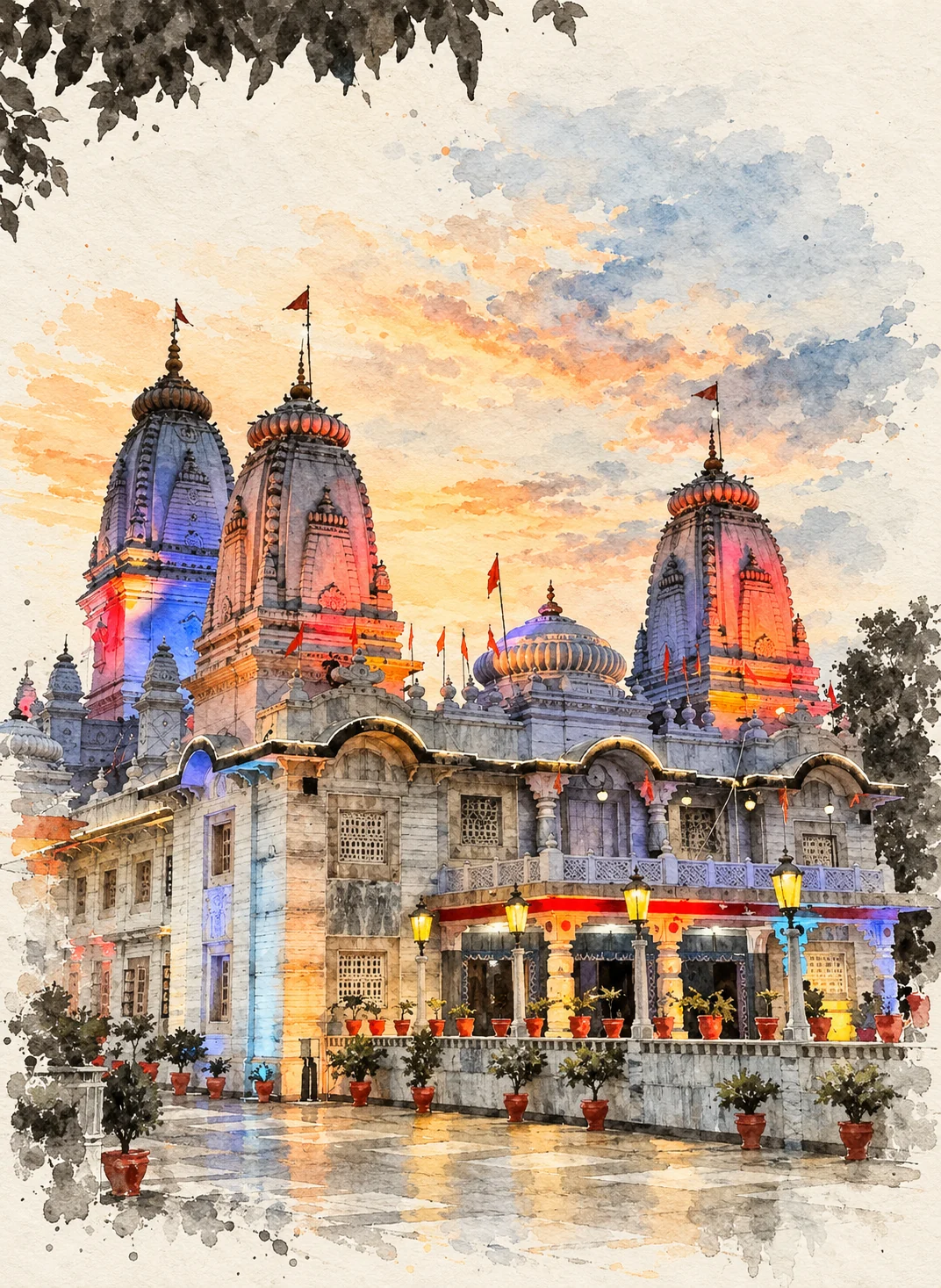
Gorakhnath Temple at dusk Arrive before the evening aarti
Gorakhnath Temple is the landmark most immediately associated with Gorakhpur, and evening is an excellent time to experience it.
The temple is one of the principal centres associated with the Nath tradition and is both a place of worship and a major part of the city's cultural identity.
Instead of visiting in the heat of midday, aim to arrive while there is still some natural light. Walk through the complex, become familiar with the grounds and then stay as the atmosphere changes towards evening worship.
Evening aarti
Unlike Geeta Vatika, the Gorakhnath Temple publishes its aarti schedule on its official website.
The current schedule lists:
Morning Mangal Aarti: 3:00–4:00 AM
Bhog Aarti: from 11:00 AM
Evening Aarti: 6:00–8:00 PM. Gorakhnath MandirFor this itinerary, the 6:00–8:00 PM period is ideal.
You don't necessarily need to remain for the entire two-hour span. Allow enough time to experience the temple before, during and after part of the evening worship.
Give the complex time
This is not a place to photograph the entrance, spend ten minutes inside and leave.
The official temple material highlights inscriptions connected with Gorakhbani and imagery relating to the Nath tradition within the complex. Gorakhnath Mandir
Take time to observe the details and the movement of devotees through the grounds.
Festival warning
The atmosphere changes enormously around Makar Sankranti and the Khichdi Mela. If you are visiting during that period, expect substantially greater crowds and alter the day's timing accordingly.
End Day 2: Dinner and an early night. Day 3 requires a morning departure.
Day 3: Kushinagar Day Trip
- Start / end
- After breakfast to evening
- Pace
- Dedicated day excursion
Kushinagar should not be squeezed into a quick half-day add-on.
The Gorakhpur district administration places it about 51 kilometres east of Gorakhpur and identifies it as one of the principal sacred places associated with the life of the Buddha. Gorakhpur
Its significance comes from its association with the Buddha's Mahaparinirvana.
That history, combined with the international Buddhist temples established around the town, makes Kushinagar feel completely different from Gorakhpur.
Leave after breakfast
An early departure gives you enough time to see the important sites without constantly checking the clock.
Road conditions and traffic determine the exact journey time, so avoid scheduling the morning around an overly precise arrival.
Once there, begin with the site that defines Kushinagar.
-
Stop 01
Mahaparinirvana Temple
The Mahaparinirvana Temple is the emotional centre of the visit.
Inside is the well-known reclining image of the Buddha, which the district administration describes as a 6.10-metre monolithic red-sandstone image dating to around the fifth century CE. Gorakhpur
There is little value in rushing through this space.
Walk around the complex, spend time near the temple and allow for the fact that visitors may be praying or meditating rather than simply sightseeing.
Even travellers without a personal Buddhist practice often find this a contemplative stop because of the site's historical and spiritual significance.
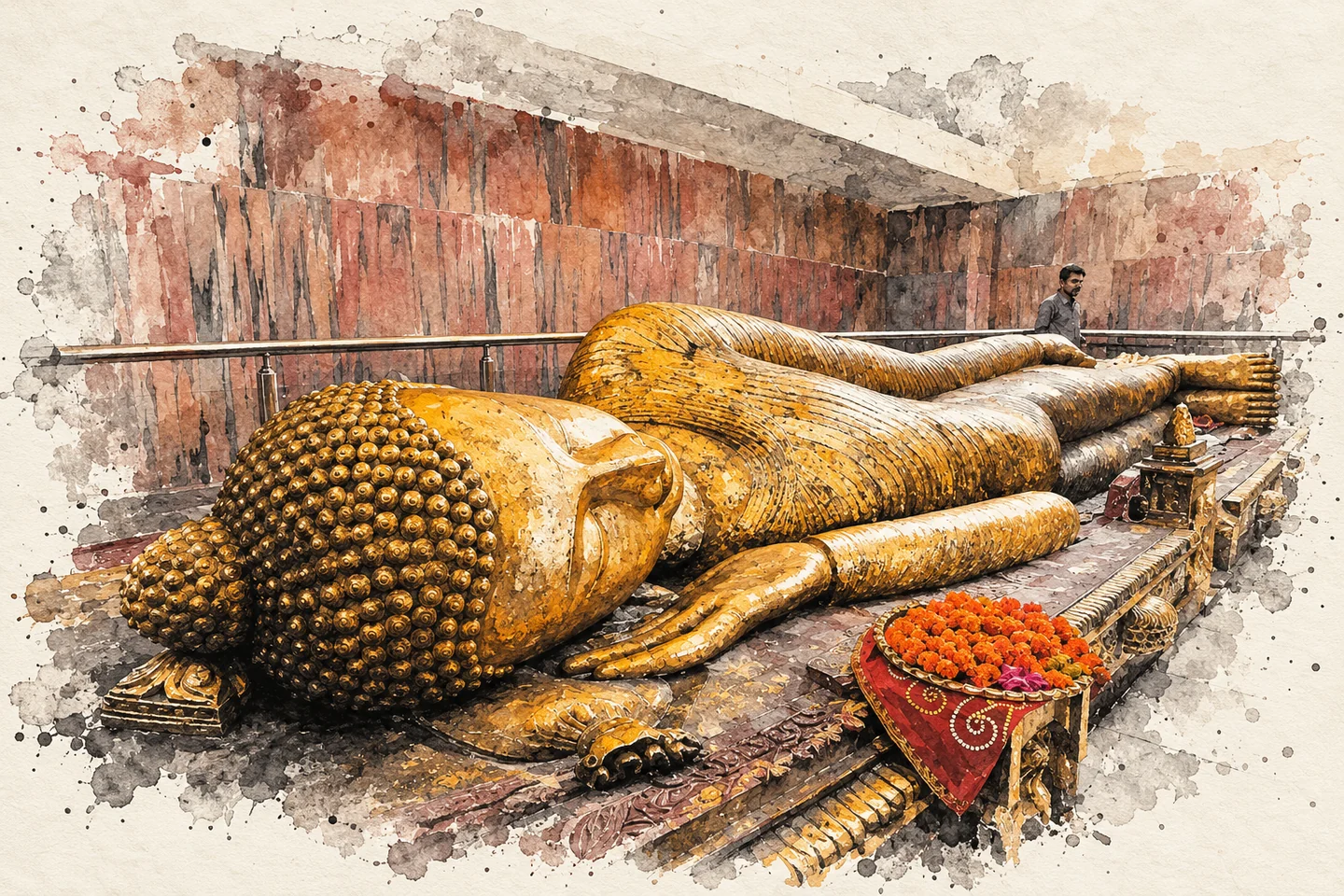
The reclining Buddha at Mahaparinirvana Temple, Kushinagar -
Stop 02
Ramabhar Stupa
From the Mahaparinirvana area, continue to Ramabhar Stupa, associated with the Buddha's cremation.
The site is visually simpler than a large temple complex, which is part of its appeal.
There is less to “see” in a conventional sightseeing sense and more reason to understand where you are.
Allow enough time to walk around rather than arriving solely for a photograph.
-
Stop 03
International Buddhist Temples
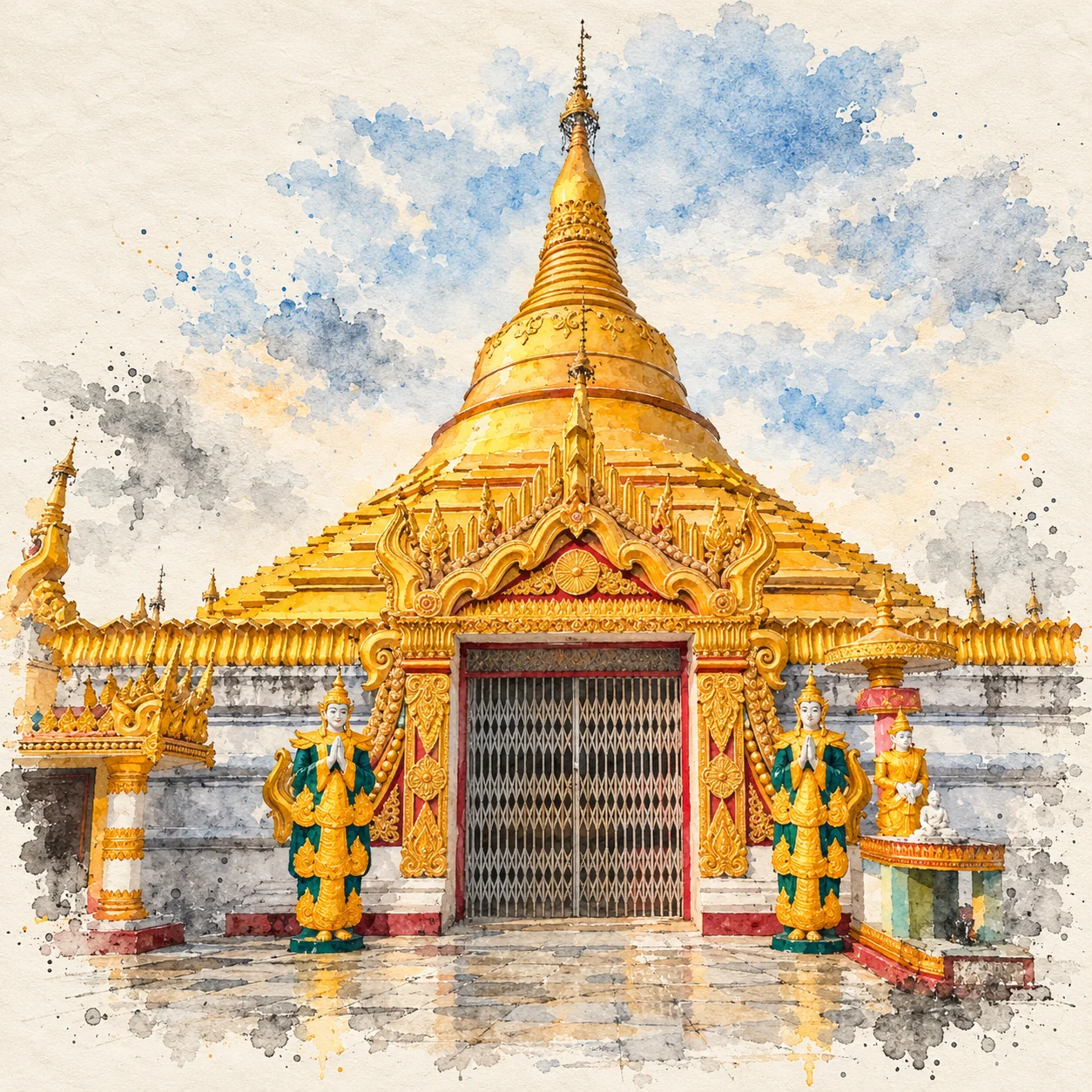
Golden pagoda, Kushinagar One of the fascinating things about modern Kushinagar is the way Buddhist communities from different countries have created temples and monasteries here.
The district tourism information identifies Thai, Chinese, Burmese, Korean, Sri Lankan, Tibetan, Indo-Japanese and other Buddhist institutions among the attractions around Kushinagar. Gorakhpur
Do not try to visit every one.
Choose two or three depending on access, interest and how much time you spent at the main archaeological sites.
That keeps the day meaningful rather than turning it into a race between temple gates.
-
Stop 04
Lunch & Return to Gorakhpur
Take a proper lunch break before leaving Kushinagar.
The aim is to reach Gorakhpur by late afternoon rather than late evening, leaving one flexible final experience.
This is why we are not adding the terracotta village to the Kushinagar day. Even though it can appear efficient on a map, combining too much would make the day unnecessarily long and weaken both experiences.
-
Optional stop
Rail Museum or Ramgarh Tal
You have two options.
Option A — Rail Museum
If you return early enough and still have energy, visit Gorakhpur's Rail Museum.
The museum includes vintage railway exhibits, regional railway history and a toy train. The Government of India's museum directory lists hours of 2:00 PM–8:00 PM, while the Gorakhpur district administration confirms that it is closed on Mondays. Because operational timings can change, check before heading there. Ministry of Culture
This option works particularly well for families with children or anyone interested in railway history.
Do not force it
If Kushinagar ran later than planned, skip the museum.
You will gain very little by rushing into it 30 minutes before closing simply because it appeared on an itinerary.
Option B — Return to Ramgarh Tal
For many visitors, this is actually the better ending.
Go back to Ramgarh Tal without any agenda.
You saw it on your first evening as someone newly arrived in Gorakhpur. Returning after three days gives the same place a different feeling.
Take an easy walk, sit by the water or simply spend the final hour of the trip somewhere familiar before dinner.
For couples or travellers without children, consider choosing this over squeezing in one more museum.
Make the Itinerary Your Own
Travelling With Children
The main itinerary works for families, but you can make one substitution if the children need something more recreational.
Gorakhpur also has the Shaheed Ashfaq Ullah Khan Prani Udyan, commonly known as Gorakhpur Zoo. Rather than adding it to an already full day, substitute it for the terracotta village if wildlife will hold the family's interest better than a craft experience.
Do not add both to Day 2.
That would turn a well-paced day into unnecessary sightseeing.
Only Have Two Days
Keep Day 2 exactly as written: Geeta Vatika, terracotta and Gorakhnath Temple.
For the other day, choose between:
Gorakhpur itself: Gita Press + Ramgarh Tal + another city attraction
or
Kushinagar: devote most of the day to the excursion.
Trying to do Gorakhpur's major sites and Kushinagar properly within the same day is possible, but not particularly enjoyable.
Practical Travel Notes
A Note About Mondays
This itinerary is not tied to specific weekdays, but there is one useful planning rule.
The Rail Museum is closed on Monday. If Day 3 falls on a Monday, choose Ramgarh Tal for the final evening instead. Gorakhpur
The main three-day route itself — Ramgarh Tal, Geeta Vatika, the terracotta village, Gorakhnath Temple and Kushinagar — remains workable without the museum.
Best Time to Visit Gorakhpur
For most travellers, October through March provides the most comfortable conditions for sightseeing.
December and January mornings can feel cool, particularly if you're leaving early for Geeta Vatika. Carry a light layer.
April to June can become very hot, making the midday portions of the itinerary less pleasant. If travelling during the hotter months, the structure we've used here becomes even more important: temples early or late, rest through the hottest part of the afternoon, and outdoor walks towards evening.
During the monsoon, expect humidity and occasional disruption to outdoor plans.
Getting Around Gorakhpur
Within the central city, auto-rickshaws, e-rickshaws and cabs make short journeys straightforward.
For Aurangabad Terracotta Village and Kushinagar, arrange a private cab or car.
It simplifies the day, avoids waiting for multiple transport connections and gives you control over how long you stay at each stop.
For Kushinagar in particular, ask the driver to remain available for the entire excursion rather than arranging separate one-way transfers.
What to Wear
There is no special tourist dress code for Gorakhpur, but temple visits deserve basic respect.
Clothing that comfortably covers shoulders and knees works well, particularly at Geeta Vatika and Gorakhnath Temple. Wear footwear that is easy to remove and put back on.
If travelling in winter, carry something light for early mornings and evenings.
For the terracotta village, comfortable shoes are preferable to formal footwear because you are visiting a working village environment rather than a polished indoor attraction.
Photography
Ramgarh Tal and the terracotta experience are naturally photogenic.
At temples, however, never assume that photography is permitted everywhere simply because other visitors are using phones.
Follow instructions at the site, particularly in shrine areas.
At Aurangabad, ask before photographing individual artisans at close range. It takes only a few seconds and makes the visit considerably more respectful.
Frequently Asked Questions
Is three days enough for Gorakhpur?
Yes. Three days gives a first-time visitor enough time to experience Gorakhpur without rushing while also including a proper Kushinagar day trip. The key is not trying to include every museum, temple and park in the city.
What should I see first after arriving in Gorakhpur?
If you arrive during the day, settle in first and visit Ramgarh Tal in the late afternoon. Gita Press can be added beforehand if your arrival time allows and the subject interests you.
What time should I visit Geeta Vatika?
Early morning is the best experience. A current visitor guide lists morning aarti from 7:00–8:00 AM, while official district information confirms the site's longstanding continuous devotional chanting. Confirm the current aarti timing before visiting because festival schedules may differ. srimandir
Why visit Aurangabad Terracotta Village?
Because Gorakhpur Terracotta is not simply a souvenir associated with the city; it is a living GI-recognised craft practised by artisan families in villages including Aurangabad. Visiting the village gives context to the clay, techniques and people behind the finished objects. Handicrafts
Can I buy terracotta directly from artisans?
Often, yes. Availability depends on the artisan and what is being produced at the time. If purchasing directly is important to you, arrange the visit beforehand rather than simply arriving unannounced.
What time is the evening aarti at Gorakhnath Temple?
The temple's official website currently lists the evening aarti from 6:00 PM to 8:00 PM. Gorakhnath Mandir
Can Kushinagar be visited as a day trip from Gorakhpur?
Yes. Kushinagar is approximately 51 km east of Gorakhpur, making it well suited to a dedicated day excursion by car. Gorakhpur
What are the current direct flights to Gorakhpur?
The Airports Authority of India currently lists direct connections from Delhi, Mumbai, Hyderabad and Kolkata. Flight routes can change, so check current schedules before booking. AAI
Is Ramgarh Tal better during the day or evening?
For this itinerary, evening is better. Arriving before sunset gives you daylight, sunset and the illuminated lakefront atmosphere in a single visit.
Is the Rail Museum essential?
No. It is deliberately an optional final stop. It works particularly well for families and railway enthusiasts, but after a full day in Kushinagar many visitors will enjoy a relaxed Ramgarh Tal walk more.
Stay in Gorakhpur
STAYING IN GORAKHPUR
A central location makes this particular itinerary easier because each day moves in a different direction.
Day 1 stays largely within the city. Day 2 moves towards Geeta Vatika and the Bhathat/Aurangabad side before returning to Gorakhnath Temple. Day 3 heads east towards Kushinagar.
10 Park Street Hotel & Banquets, on Park Road in Civil Lines, provides a central base for following this itinerary while keeping restaurants, city transport and the railway area within convenient reach.